Bridgeworks AI
The API behind a family's private archive
For Kinloom, an app where families record and share their stories, we built the API, set up its home on Google Cloud and connected the services around it.
- Client
- Bridgeworks AI
- Year
- 2026
- What we did
- API development, Google Cloud setup, Integrations
Kinloom is a private app where families record their stories in text, photos and audio, and share them with the relatives they choose. Bridgeworks AI's own team builds the apps people use. We built the API those apps talk to, set up its production home on Google Cloud, and connected the services it relies on.
The problem
A family's stories are about as private as data gets. Before the API returns anything, it has to answer one question: may this person see this? The answer has to hold for a story kept to oneself, one shared with a household, one shared with the wider family, and one held back until after its author has died.
What we built
An API of 81 endpoints, built in Laravel on PostgreSQL. It covers accounts and family groups, stories with photos and audio, sharing, a full export of a family's own data, and an assistant that answers questions from a family's stories.
Ten access rules decide who may see what. Each is written as tests that run against the real API, more than 150 of them, before every release. When someone asks for something they may not see, the API answers exactly as if it did not exist.
81
API endpoints
2,500+
automated tests
10
access rules, each written as tests
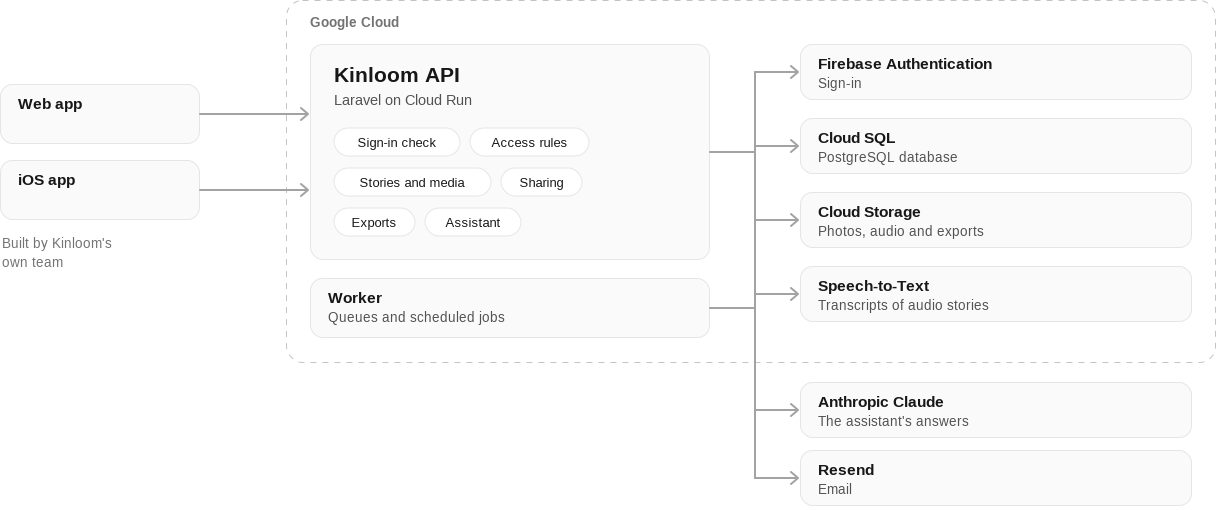
A home on Google Cloud
Production runs on Google Cloud Run. The API scales with demand, and a separate worker handles queued and scheduled jobs such as transcription and exports. Data lives in a managed PostgreSQL database with daily backups and point-in-time recovery, and the database takes no connections from the public internet.
Photos and audio sit in private storage. Secrets are kept in a secret manager, and nothing signs in with a stored key file. The whole setup is written in Terraform, so every change is reviewed as a plan before it is applied.
Releases that check themselves
A release starts with the full test suite, the access rules included. Database changes run next, and a failed one stops the release with the running version untouched. The pipeline signs in to Google Cloud without a stored key, and it finishes only when the live API reports the new version.
The services around it
Sign-in uses Firebase Authentication. Photos and audio upload straight to storage through short-lived signed links. Audio stories are transcribed with Google Speech-to-Text. Email goes out through Resend. The assistant uses Anthropic's Claude and answers only from the family's own stories.
Where it stands
The production API has been live since November 2026, and Kinloom is about to launch.
Tech stack
Have a similar challenge?
We'd love to hear about your project. Let's talk about how we can help.
Start a conversation